Showing posts with label French Polynesia. Show all posts

Wednesday, 23 July 2025

Ancient eastward migration traced in genes

From "Eurasian Bookshelf" on Facebook -  

https://www.facebook.com/photo/?fbid=1202752154987561&set=a.527495192513264: A Story Written in DNA


The Development of the East Eurasian Phenotype

The East Eurasian phenotype — the set of physical traits common among many East Asian, Siberian, and some Southeast Asian populations — didn’t appear overnight. It developed over tens of thousands of years as ancient human populations adapted to diverse climates, diets, and environments across the vast lands east of the Eurasian Steppe.

Modern genetic studies suggest that many distinctive traits — including epicanthic folds, shovel-shaped incisors, thicker hair shafts, and skin tone variations — evolved as adaptive responses to cold climates, UV radiation, and dietary factors during the Upper Paleolithic (roughly 40,000–10,000 years ago).

These traits are believed to have crystallized among ancient hunter-gatherer populations in northern and eastern Asia, particularly in regions like Siberia, the Yellow River basin, and the Amur River valley. Later migrations spread this phenotype widely — into China, Korea, Japan, and Southeast Asia — blending with local groups over millennia.

Genetics also shows fascinating connections between East Eurasians and Native Americans, who migrated across Beringia during the Ice Age, carrying parts of this shared ancestry into the New World.

This story is still unfolding, thanks to ancient DNA research — revealing how migration, climate, and time have shaped the diversity of human appearance across continents.

Friday, 10 July 2020

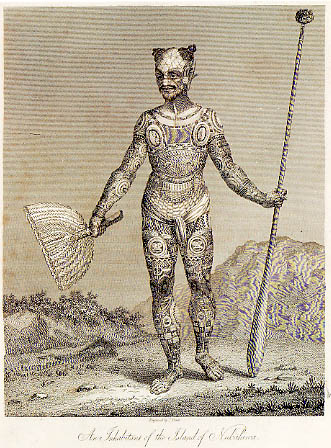
MARQUESAS ISLANDS: A tattooed warrior

Not yet finished but still impressive - fearsome:

http://www.vanishingtattoo.com/tattoo_museum/polynesian_tattoo_images.html

'The German explorer and ethnologist Karl von den Steinen, who visited the isles in 1891, listed over one-hundred and seventy individually named tattooing motifs which is remarkable since the tradition was "banned" by French officials approximately fifty years before that time.'
http://www.vanishingtattoo.com/tattoo_museum/marquesas_tattoos.html

The same site shows some striking female tattoos also - it's intriguing to see what parts were not decorated. http://www.vanishingtattoo.com/tattoo_museum/marquesas_tattoo_images.html

A Nuku Hiva warrior, complete (1813):
https://upload.wikimedia.org/wikipedia/commons/7/76/Nuku_Hiva_warrior_1813.jpg

Wednesday, 8 July 2020

FRENCH POLYNESIA: C13th Polynesians migrated east, Colombians west, met in French Polynesia?

'After a detailed DNA analysis of the genomes of more than 800 Polynesians and Native Americans, both modern and prehistoric, researchers have found evidence of contact between the two groups as far back as 1200 CE...

"Our analyses suggest strongly that a single contact event occurred in eastern Polynesia, before the settlement of Rapa Nui, between Polynesian individuals and a Native American group most closely related to the indigenous inhabitants of present-day Colombia," the researchers explain in their paper.

https://www.sciencealert.com/new-evidence-shows-prehistoric-contact-between-native-americans-and-polynesians

See also this article from 2017, reporting a study supporting the theory that the Native American / Polynesian interbreeding occurred before the colonisation of Rapa Nui:
https://www.sciencemag.org/news/2017/10/did-early-easter-islanders-sail-south-america-europeans

Wednesday, 27 September 2017

TONGA: Island now free of elephantiasis

https://upload.wikimedia.org/wikipedia/commons/1/15/Elephanti.jpg

Like many places around the world, the Pacific islands have long been plagued with the mosquito-born disease lymphatic filariasis, also known as elephantiasis. Now (as of end July 2017) the World Health Organization has declared Tonga free of it. The Marshall Islands were declared free a few months earlier, in March.

The disfiguring and sometimes fatal disease was noted by the late eighteenth century explorer James Cook in his travels in the South Seas, but it has a much longer history. It was known in Goa since at least the sixteenth century and thought to have been present in the Middle East thousands of years before.

Filariasis was present in Tahiti (French Polynesia) in 1954 when the writer H E Bates visited there (at the suggestion of the filmmaker David Lean). In the third volume of his autobiography ("The World In Ripeness", 1972), Bates tells (p. 136) how a fellow passenger in the plane that took him there was an American doctor carrying a box of giant mosquitoes that he hoped would eat the smaller local ones that are a vector for the disease. Sadly, it's still a risk there, but of the 22 Western Pacific countries and territories in the WHO's eradication programme (see p. 18 here), 4 (Cook Islands, Marshall Islands, Niue and Vanuatu) have succeeded and the work goes on.

Saturday, 12 March 2016

FRENCH POLYNESIA: Image - Bora Bora, from space


Bora Bora, French Polynesia, 4 October 1994

Radar image from NASA
http://visibleearth.nasa.gov/view.php?id=52452

Saturday, 5 March 2016

FRENCH POLYNESIA / NEWS - Tahiti: new biohazard laboratory opened


Friday, 4 March 2016: Tahiti News announces the opening of a new high-biosafety laboratory at the Malardé Institute in Pape'ete.(1)

This is to help deal with the increased risk of infectious diseases that have spread to and from the Pacific region, such as Chikungunya (2), Zika (3) - which was first discovered in Uganda in 1947 (4), dengue (5), H1N1 influenza (6).

An earlier article from FranceTV (7) explains that highly dangerous diseases need to be handled in very safe facilities, which up till now did not exist in French Polynesia. Previously samples would have had to be sent to other laboratories abroad, which cost precious time.

The new lab on Tahiti is equipped to NSB3 containment standard. This is not the highest category - level 4 is for very high risk pathogens such Ebola, Lassa, Marburg etc and "other agents with unknown risks of pathogenicity and transmission" (8).

The top biosafety rating includes germ warfare research facilities such as the UK's Porton Down, listed on Wikipedia (9). One obvious reason why the "space suit" level 4 isn't appropriate for Tahiti is the risk of destructive tropical storms like the Category 5 Cyclone Winston that crashed into Fiji last month, killing 43 people (10). French Polynesia is 2,100 miles further east but is still not immune: in 2010 Cyclone Oli hit Tahiti with gusts up to 120 mph (11), and in 1997 Cyclone Osea wrecked 95% of the infrastructure of Maupiti, 200 miles NW of the main island (12).

So we needn't worry about an Andromeda Strain-type (13) accidental plague weapon release: it's not that kind of operation.
___________________________________

(1)  http://www.tahitinews.co/inauguration-dun-laboratoire-de-haute-securite-biologique/
(2) http://www.cdc.gov/chikungunya/geo/ - very widespread globally
(3) http://www.cdc.gov/zika/geo/ - also spreading via  mosquito in Samoa and Tonga, for example
(4) https://www.geneticliteracyproject.org/2016/03/03/zika-connection-microcephaly-guillain-barre-hard-prove/
(5) http://wwwnc.cdc.gov/travel/yellowbook/2016/infectious-diseases-related-to-travel/dengue - throughout S E Asia and the western Pacific
(6) http://www.gleamviz.org/2009/09/ - spread around the world by air travel in months
(7) http://la1ere.francetvinfo.fr/polynesie/tahiti/installation-d-un-laboratoire-de-haute-securite-biologique-l-institut-malarde-197064.html - dateline 9 Oct 2014, updated 25 Feb 2016
(8) http://www.labmanager.com/lab-health-and-safety/2010/12/biosafety-levels-1-2-3-4?fw1pk=2#.VtrtvX2LSt9
(9) https://en.wikipedia.org/wiki/Biosafety_level#Biosafety_level_4
(10) http://fijione.tv/43-dead-after-tc-winston/
(11) https://en.wikipedia.org/wiki/Cyclone_Oli#Tahiti_2
(13) https://en.wikipedia.org/wiki/The_Andromeda_Strain