Showing posts with label Images. Show all posts

Friday, 10 July 2020

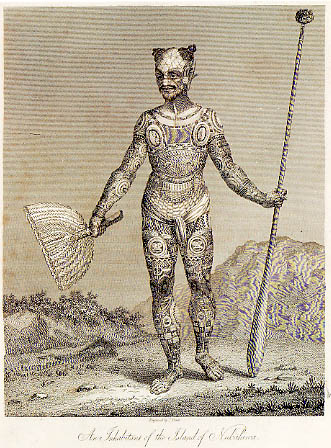
MARQUESAS ISLANDS: A tattooed warrior

Not yet finished but still impressive - fearsome:

http://www.vanishingtattoo.com/tattoo_museum/polynesian_tattoo_images.html

'The German explorer and ethnologist Karl von den Steinen, who visited the isles in 1891, listed over one-hundred and seventy individually named tattooing motifs which is remarkable since the tradition was "banned" by French officials approximately fifty years before that time.'
http://www.vanishingtattoo.com/tattoo_museum/marquesas_tattoos.html

The same site shows some striking female tattoos also - it's intriguing to see what parts were not decorated. http://www.vanishingtattoo.com/tattoo_museum/marquesas_tattoo_images.html

A Nuku Hiva warrior, complete (1813):
https://upload.wikimedia.org/wikipedia/commons/7/76/Nuku_Hiva_warrior_1813.jpg

Monday, 4 April 2016

AUSTRALIA: Ancient art in Arnhem Land

"Australia rock art - Mimis and Kangaroo, rock art, Oenpelli, Arnhem Land, Australia. Older painting before 7,000 BCE, Kangaroo probably post-contact. (Sayre, 2010, p. 975)" - https://uk.pinterest.com/pin/521502831831829461/


Bill Harney, looking at cave art in Arnhem Land in the 1940s:

Kangaroos, bandicoots, fish, reptiles - all are drawn nice and fat because he desires them that way.

Many of the paintings have been drawn as though seen through an X-ray, and beholding them we are amazed at the line details of the creature's internal organs. I questioned one of the artists who was working on a bark painting, and he described things to me.

"This," he explained, as he pointed out an object amidst the intestines, "is the fat." Then, with emphasis, "Proper fat this one." "That there," again on the anatomy, "is the heart. This red thing is the liver and the fine white lines are the backbone."

Each part was pointed out and it was correctly in place. Nothing strange about this, because these people had been cutting up and eating these things for years. They were professional anatomists when the drawings of the ancient white doctors would have been laughed at by an Oenpelli aborigine.

It was on those hills around Oenpelli that I saw the matchstick art that is so full of animation. My guide told me that it was the work of "Me-mies", the mythical bush elves who are "too clever" to be seen, and who draw these things, in the dark, from a paint made up of human blood and charcoal. Those "Me-mies" were indeed "too clever" - a few strokes on the rocky face and the picture was a group of natives fleeing from another.

I asked the native what he thought about them. He only shrugged his shoulders in reply, but shortly afterwards when we came upon a meaningless thing of coloured ochres and lines his voice vibrated with pride as he explained it in detail. The lines were the falling rain; the red streaks were the lightning thrown by a sky hero; the dots were the rain drops splashing on the ground below, which was another splash of ochre; the wriggly lines were the rivers in flood.

"Good picture?" I questioned him, as he stood expectantly by awaiting my decision. "Proper good," came his reply. "Plenty rain... full up tucker."

- "Life Among The Aborigines" by W. E. Harney, Robert Hale Limited (1957) - pp. 117-118
_______________________________________

Writing in 2013 about the estimated 100,000 sites of aboriginal Australian art, Susan Gough Henly says:

"In spite of extensive studies, it is still extremely difficult to pinpoint the age of rock art because most organic pigments cannot be carbon dated. A rare charcoal drawing on the Central Arnhem Land Plateau has been radiocarbon-dated to 28,000 years ago, making it the oldest painting in Australia and among the oldest in the world with reliable date evidence – but the engravings are probably much older."

- https://www.griffith.edu.au/__data/assets/pdf_file/0005/537962/Australian-Traveller-2013-Sue-Henly-rock-art1.pdf

What is thought to be the oldest cave painting in the world - from Sulawesi in Indonesia - has been dated to at least 39,000 years ago. It is a hand stencil (something also found at Oenpelli):

http://anthropology.net/2014/10/08/39000-year-old-cave-art-from-sulawesi-indonesia/

Sunday, 20 March 2016

AUSTRALIA: "First Film Made of Arnhem Land Natives"

"Table manners may seem crude but it is not very long ago that the people of Britain were eating with their hands."

 This film, "Primitive Peoples Part 1" by G. B. [Gaumont British] Instructional Ltd is careful not to condescend (1). Actor Peter Finch, already famous in Australia for his radio work, assisted with shooting as well as narrating (2).

The people shown are said to be of the "Miwai", though their territory as described is that of the Yolngu and one or two of the sub-groups named are recognisably in the Yolngu list in Wikipedia (3). The press article from the Melbourne Argus (23 August 1947) names the tribe as "Wongurris" and says they were paid with around a ton of food supplies (4).

The film crew's guide and liaison officer was Edward "Ted" Evans of the Native Affairs Branch in Darwin - he terms the tribe Wangurri in his 1990 memoir of Arnhem Land. Evans had become familiar with the area and its people at the end of World war 2, when the Royal Australian Air Force Base on Gove Peninsula was decommissioned and for some reason he and writer Bill Harney were left there for five months after they had finished stocktaking. "To me the whole 1946 Gove Peninsula experience was a revelation of the richness of the Aboriginal world, of the fascinating variety of wildlife on our doorstep and particularly of the depth of understanding and mutual respect that existed between Bill Harney and the Aboriginal people." (5)


So far I have not found Parts 2 and 3 of the film - according to Evans, the only copy in Australia was held by the Australian Institute for Aboriginal Studies.

Evans concludes, "In 1972, I acquired for the first time copies of the Gaumont British film made in 1947.1 took it out to Yirrkala, but as twenty-five years had elapsed and therefore some of those appearing had since died, I showed it first only to the elders to get their reaction before running it before the general community. Their reaction was one of wistful sorrow, followed by a request that I not show it publicly - not because of any taboo content of which there is none. but because'of the sadness they felt personally on observing the living activities of persons now dead. Of course, I complied with their request.

"I retired in 1976 almost thirty years after my first arrival at Melville Bay with Bill Harney. In that time I developed a strong feeling for Arnhem Land and a high regard for its people. particularly those of Yirrkala. This esteem still continues and I value the contacts I am able to make occasionally thereby maintaining a nostalgic link with a crowded, but fading past. I look back on my involvement with some pride and I trust that my humble efforts may have helped the people to face and cope with the dramatic, complex and fast-moving changes that were brought upon them over that span of years. Rarely in the history of mankind has a people, within the span of one generation, been required to make adjustments to their lifestyle which have impacted upon almost every vital element of their traditional world."
_____________________________

(1) http://www.bfi.org.uk/films-tv-people/4ce2b87a9557a - The film is dated 1950 but the press coverage (see 4 below) is from 1947
(2) https://en.wikipedia.org/wiki/Primitive_Peoples
(3) https://en.wikipedia.org/wiki/Yolngu
(4) http://trove.nla.gov.au/newspaper/article/22438457
(5) http://www.artsandmuseums.nt.gov.au/__data/assets/pdf_file/0010/114958/occpaper12.pdf

Friday, 18 March 2016

Sunday, 13 March 2016

SCIENCE: 2016 solar eclipse, from Woleai

Recording of last week's (8 March 2016) total solar eclipse, seen live from a coral island in Micronesia:


Location:


Woleai (aka Oleai), eastern Caroline Islands, Federal States of Micronesia
Images: Google Maps / NASA

See Wikipedia on Woleai: https://en.wikipedia.org/wiki/Woleai

Saturday, 12 March 2016

AUSTRALIA: Dancing at Alice Springs


"Tjitjingalla Corroboree performed in Alice Springs, 1901." 


"The picture depicts one of the dance sequences of the Tjitjingalla as performed by Arrernte people at Alice Springs.

Image: Sir Walter Baldwin Spencer
Source: Museum Victoria"

https://museumvictoria.com.au/about/mv-blog/sep-2011/following-the-travelling-tjitjingalla/

MARSHALL ISLANDS: Image - Bikini Atoll, Marshall Islands


Bikini Atoll, from space (19 August  2013)
Image from NASA - http://earthobservatory.nasa.gov/IOTD/view.php?id=83237

The 1954 H-bomb crater is at top left.
More about Bikini here: 
https://en.wikipedia.org/wiki/Bikini_Atoll

FRENCH POLYNESIA: Image - Bora Bora, from space


Bora Bora, French Polynesia, 4 October 1994

Radar image from NASA
http://visibleearth.nasa.gov/view.php?id=52452