Saturday, 11 July 2020

MADAGASCAR: How (why) did Austronesians come to Madagascar?

The eastward migration - taking place around the year 500, it is thought - is a mystery:

'One can only assume that the island of Madagascar played an important role in trade, particularly that of spice trade (especially the cinnamon) and timber between Southeast Asia and Middle East, directly or through the African coast and Madagascar.'

https://en.wikipedia.org/wiki/History_of_Madagascar#First_inhabitants_and_settlements_(500_BCE%E2%80%93700_CE)

Source: Wikipedia


Friday, 10 July 2020

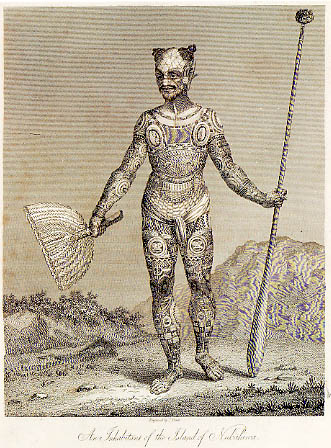
MARQUESAS ISLANDS: A tattooed warrior

Not yet finished but still impressive - fearsome:

http://www.vanishingtattoo.com/tattoo_museum/polynesian_tattoo_images.html

'The German explorer and ethnologist Karl von den Steinen, who visited the isles in 1891, listed over one-hundred and seventy individually named tattooing motifs which is remarkable since the tradition was "banned" by French officials approximately fifty years before that time.'
http://www.vanishingtattoo.com/tattoo_museum/marquesas_tattoos.html

The same site shows some striking female tattoos also - it's intriguing to see what parts were not decorated. http://www.vanishingtattoo.com/tattoo_museum/marquesas_tattoo_images.html

A Nuku Hiva warrior, complete (1813):
https://upload.wikimedia.org/wikipedia/commons/7/76/Nuku_Hiva_warrior_1813.jpg

Wednesday, 8 July 2020

FRENCH POLYNESIA: C13th Polynesians migrated east, Colombians west, met in French Polynesia?

'After a detailed DNA analysis of the genomes of more than 800 Polynesians and Native Americans, both modern and prehistoric, researchers have found evidence of contact between the two groups as far back as 1200 CE...

"Our analyses suggest strongly that a single contact event occurred in eastern Polynesia, before the settlement of Rapa Nui, between Polynesian individuals and a Native American group most closely related to the indigenous inhabitants of present-day Colombia," the researchers explain in their paper.

https://www.sciencealert.com/new-evidence-shows-prehistoric-contact-between-native-americans-and-polynesians

See also this article from 2017, reporting a study supporting the theory that the Native American / Polynesian interbreeding occurred before the colonisation of Rapa Nui:
https://www.sciencemag.org/news/2017/10/did-early-easter-islanders-sail-south-america-europeans

Friday, 22 May 2020

ORIGINS: Neanderthal builders in France...

... 176,000 years ago: https://bigthink.com/robby-berman/a-cave-in-france-changes-what-we-thought-we-knew-about-neanderthals

Taken from https://www.theatlantic.com/science/archive/2016/05/the-astonishing-age-of-a-neanderthal-cave-construction-site/484070/

which was based on
https://www.nature.com/articles/nature18291

and also reported by
https://www.nationalgeographic.com/news/2016/05/neanderthals-caves-rings-building-france-archaeology/

Bruniquel Cave is in south-west France, more here:
https://en.wikipedia.org/wiki/Bruniquel_Cave

Related:

The common ancestors of the humanoids known as Neanderthals and Denisovans spread across Europe and Asia over half a million years ago, and split into the two branches, with fossils of Neanderthals found in western countries and of Denisovans in the East. What is thought to have been the first wave of Homo Sapiens came from Africa c. 270,000 years ago and some may have mated with Neanderthals.

Wednesday, 12 February 2020

ORIGINS: DNA evidence points to another unknown hominid population in Africa

https://theconversation.com/early-humans-in-africa-may-have-interbred-with-a-mysterious-extinct-species-new-research-131699

'A 2017 study of ancient DNA from southern Africa investigated 16 ancient genomes from people alive over the last 10,000 years. This showed that the history of African populations was complex. There wasn’t just a single group of humans around in Africa when they expanded out 100,000 years ago.

It’s a result that was supported earlier this year by a paper examining ancient DNA from four individuals from what is now Cameroon. Taken together, this research suggests there were geographically diverse groups in Africa well before the main expansion out of the continent. And many of these groups will have contributed to the ancestry of people alive in Africa today. [...]

The new paper provides evidence that there may also have been gene-flow into the ancestors of West Africans directly from a mysterious archaic hominin. [...]

Interestingly, they suggest that 6%-7% of the genomes of West Africans is archaic in origin. But this archaic ancestry wasn’t Neanderthal or Denisovan. Their model suggested the additional ancestry came from an archaic population for which we don’t currently have a genome.

This ghost population likely split from the ancestors of humans and Neanderthals between 360,000 and 1.02 million years ago. That was well before the gene-flow event that brought Neanderthal DNA back into West Africa around 43,000 years ago – although the value of this could be anywhere between 0 and 124,000 years ago.'